Enterprise Architecture 5.0: Defining the Next Generation
Table of Content
Table of Content
For too long, Enterprise Architecture lived in complex diagrams and binders of documentation that only a few technical people could possibly interpret. That era ends now. Enterprise Architecture 5.0 brings Enterprise Architecture into the language of business. Clear, strategic, and actionable.
Built through H.A.Cs™ (Holcman Architecture Containers), and H.I.Cs™ (Holcman implementation composites). This new model finally connects your business vision to your execution reality.
Enterprise Architecture 5.0 transforms architecture certification from multiple choice exams to demonstrated competency, from documentation to direction, from governance to guidance, and from complexity to clarity. Transform and enable your strategy. Shape your future. This is Enterprise Architecture 5.0, the real enabler of business strategy.
To the EA Community:
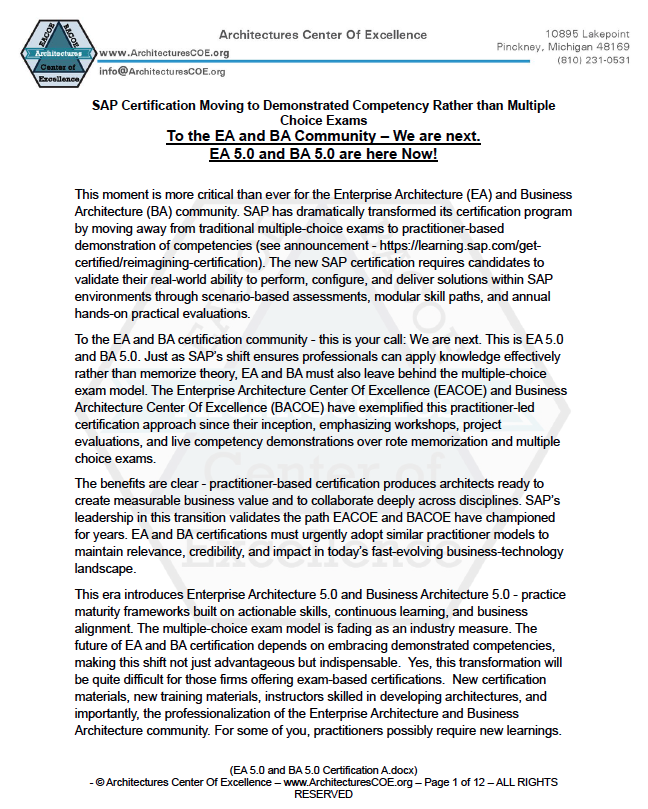
SAP’s leadership in the Certification Community, is moving them from Multiple Choice Exams to Demonstrated Competency
We in the EA Community are next- moving EA Certification from Multiple Choice Exams to Demonstrated Competency
Enterprise Architecture 5.0 is here now
Enterprise Architecture certification must evolve to mirror SAP’s modern, business-centric approach - something EACOE has championed from its inception.
With SAP’s high-profile certification validating what EACOE have long practiced, it is time for the broader Enterprise Architecture profession to catch up. Certifications built on hands-on skills, continuous learning, and direct business benefit - not just exam-based knowledge - lead to genuine enterprise impact and professional credibility.
In summary, SAP’s latest developments in certification are a public validation of the EACOE certification model, anchored in business alignment, hands-on proficiency, and maturity-driven growth.
The multiple-choice exam Enterprise Architecture community community – take note. The profession’s future - and its credibility - depend on this approach becoming the new standard. Yes, this realization has far-reaching implications for both the certification community, and more importantly, those that have their present credentials based on what is now recognized as a fading model.
The transition from traditional multiple-choice exam certifications to practitioner-based, demonstrated competency models profoundly impacts all participants within the ecosystem of Enterprise Architecture credentialing. This evolution affects professionals, organizations, hiring managers, recruiters, instructors, and certifying agencies alike. Below is a summary examination of these various effects.
Professionals holding multiple-choice exam-based certifications may face declining credential value as employer preference shifts toward proven applied skills. They will likely need to invest time and resources into re-certification, upskilling, and demonstrating real-world competencies to maintain relevance and competitiveness. This transition can introduce frustration and anxiety, but also an opportunity to deepen practical impact and career advancement.
Organizations that have relied on multiple-choice certifications for staff qualification risk skills misalignment with business needs, requiring significant investment in workforce reskilling. They face increased complexity in managing evolving credential standards and must adopt change management strategies to support smooth transitions. However, those embracing new competency models gain competitive differentiation with better-prepared teams capable of delivering measurable business outcomes.
Hiring managers relying on multiple-choice certifications encounter diminished effectiveness in screening for true skills and job fit, leading to potential hiring mismatches. Adopting competency-based evaluation processes empowers managers to identify candidates with proven practical abilities, reducing ramp-up times and enhancing team performance. This shift also prompts a broader cultural change valuing experience and skills over test results alone.
Recruiters face challenges in adapting from quick-certification keyword filters to more nuanced assessment of demonstrated competencies, increasing sourcing effort and time per hire. Developing skills-first hiring capabilities and leveraging advanced evaluation tools are critical to maintain recruiting effectiveness and support organizational talent goals. This evolution enhances recruiters' strategic value but requires upskilling.
H.A.Cs™ (Holcman Architecture Containers) do what store shelves or restaurant menus do for stakeholders and decision makers in your own business and, of course, information technology people.
They group related information in a way that our minds intuitively understand.
H.A.C.s™ define the architecture of intent, connecting your business vision to your execution reality. They represent what the organization aims to achieve and what capabilities are needed.
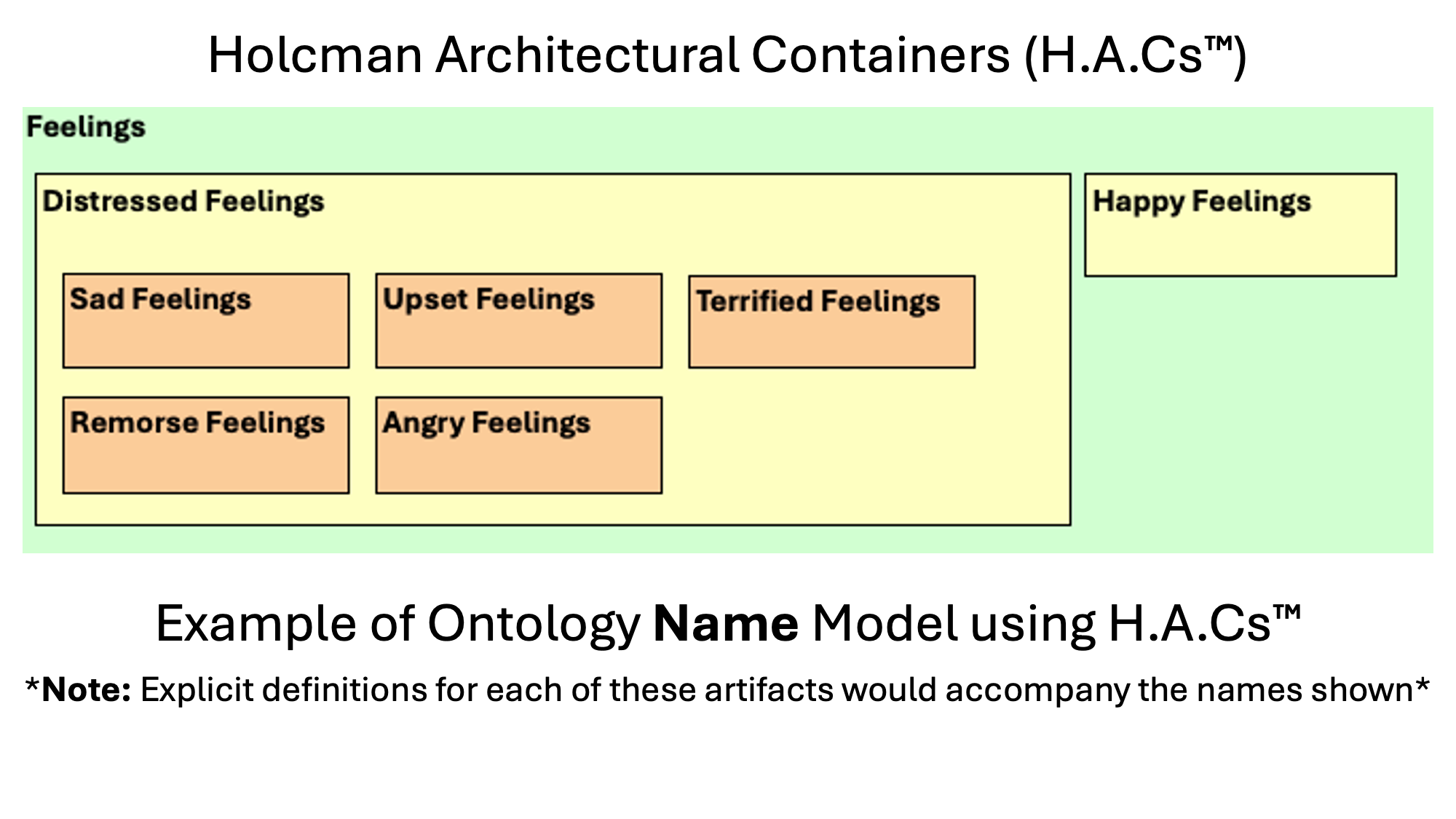
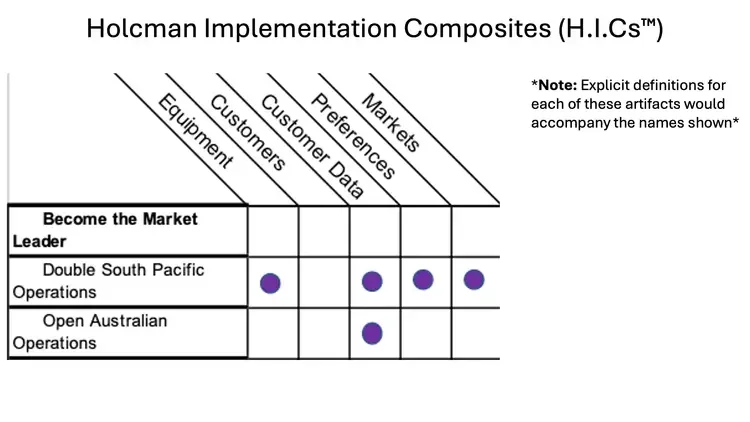
H.I.Cs™ (Holcman Implementation Composites) turn that architecture into delivery - enabling transformation pathways, investment logic, enablement of business strategy, and measurable strategic impact.
Through H.A.Cs™ we visualize where your business wants to go. Through H.I.Cs™ we make it happen.
Together, they turn architecture into a living framework that every stakeholder can understand and use to drive real outcomes.
Enterprise Architecture 5.0 - enabling business strategy through clarity, connection, and confident execution.
EACOE not only offer advanced architecture enabling tools, but we deliver a fully integrated suite of training, certification, frameworks, methodologies, consulting, mentoring, and program support designed for maximum efficiency and effectiveness.
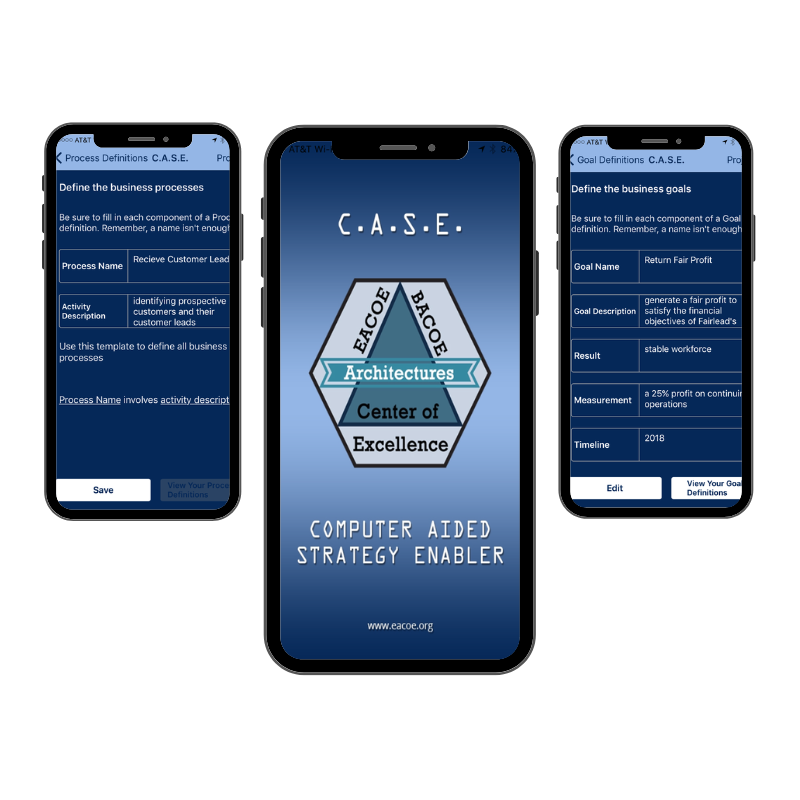
Capture the changes to your Processes, Data, Organization, Location, and Events, Align Your Business Goals, and capture the changes to your Enterprise Architecture dynamically, with the smartphone-based C.A.S.E (Computer Aided Strategy Enabler) tool from EACOE. Our proprietary capture tool is fully integrated with the all-inclusive EACOE Enabler Tool and Practitioner Suite.
Designed for minimal business intrusion, continuous change, and dynamic environments, the EACOE Enterprise Architecture Practitioner Suite provides you with the only fully integrated Framework, Methodology, Project Plan, Templates, and Smartphone and PC Tools.
Attend the EACOE Enterprise Architecture Workshop to obtain the full practitioner suite at no additional cost.