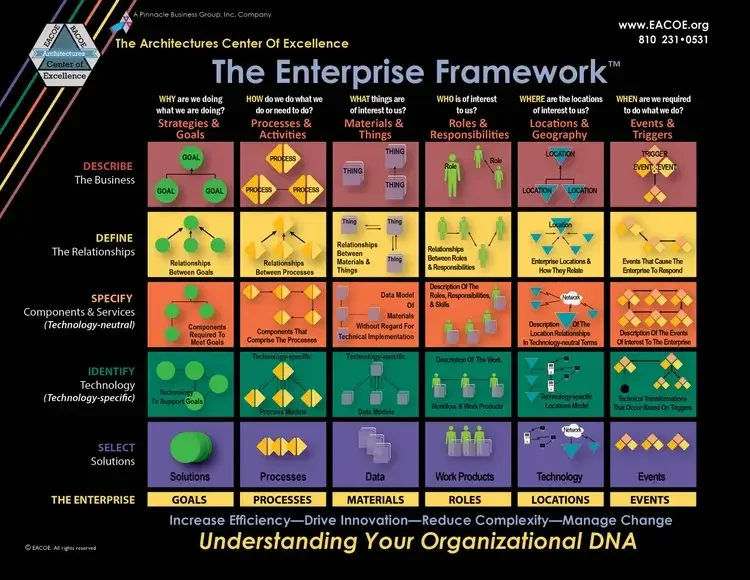
The Enterprise Framework™ identifies everything that needs to be understood about an enterprise; it is the collection of all the perspectives/transformations that represent the functioning enterprise. At the same time, not all thirty architectural views are required before an enterprise gets started. As a matter of fact, most organizations’ architectures and strategies can initially be defined by only a handful of cells, as the EACOE Quick Start Enterprise Architecture Methodology defines; different types of artifacts will be used in different situations.
However, you need to understand that every perspective and transformation is important, and each exists whether or not it is explicitly represented. Having explicit representations for each cell facilitates reuse and makes it possible to associate cells with each other: this is the ultimate in flexibility and agility, and may take some time to effect fully.
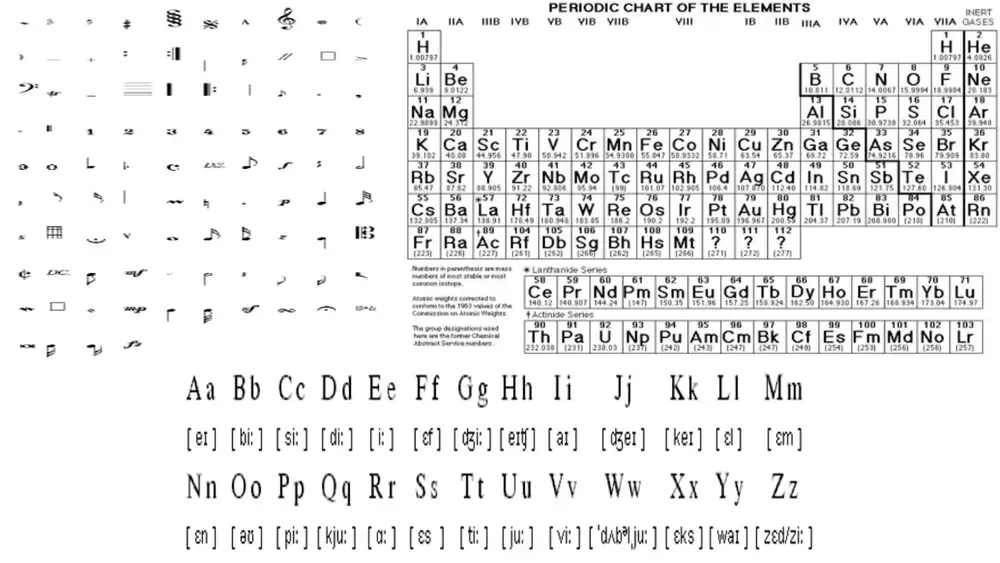
The associations make it possible to identify gaps and overlaps. Just as not all of the letters of the alphabet are required to make a word or sentence, or not all of the elements in Mendeleev’s Periodic Table are required to make a chemical compound, not all of the cells are required for a given area of analysis in an Enterprise, initially.
The Enterprise Framework, when used with the EACOE Enterprise Architecture Quick Start methodology, will produce a clear, verifiable, understandable, and effective business and technology strategy. Practitioners have found The Enterprise Framework to be easy to explain and understand. The Enterprise Framework is human consumable.
Enterprise architecture, defined in terms of the framework, leads to the acknowledgment that there is more to an organization than mere data models and functions. There are numerous other issues, multiple locations, and timing factors to consider while planning its development.