Enterprise Architect vs Solution Architect: Key Differences Explained
The Enterprise Architecture Center Of Excellence (EACOE) has trained over 165,000 professionals across Fortune 500 companies and US federal government agencies. In those workshops, one question surfaces consistently: what actually separates an enterprise architect from a solution architect, and which role should you be building toward? Both titles appear on organization charts. Both involve architecture. Both command strong compensation. Yet they operate at fundamentally different levels, with different deliverables, different decision-making authority, and different definitions of success. This article breaks down those differences so you can navigate your EA career with purpose.
What Does an Enterprise Architect Actually Do?
An enterprise architect operates at the organizational level. Their job is to understand the entire business - its strategy, its capabilities, its technology landscape, and where it needs to be in three to five years - and then ensure that every system, every project, and every technology investment moves the organization forward as a coherent whole.
Enterprise architects do not build individual solutions. They define the conditions under which solutions get built. They create frameworks, standards, and reference architectures that govern how projects are designed and delivered. When a new initiative lands on the table, the enterprise architect asks two questions: Does this align with where the organization is going, and does it fit within the architecture we have already established?
The scope is deliberately wide. Enterprise architects track external factors - competitor technology advances, regulatory shifts, emerging tools - alongside internal factors like technical debt, capability gaps, and strategic priorities. In US federal government environments, enterprise architects play a critical governance role, ensuring agency systems comply with agency missions and that technology investments align with mission objectives and congressional budget constraints.
What Does a Solution Architect Actually Do?
A solution architect works at the project level. Where the enterprise architect identifies which problems need solving at the organizational scale, the solution architect takes a specific problem and designs the technical solution that addresses it.
That means working closely with development teams, project managers, business stakeholders, and vendors to build an architecture that is technically sound, deliverable within project constraints, and cost-effective. A solution architect translates business requirements into system specifications - deciding which technologies, platforms, integrations, and design patterns will be used to build a particular system or product.
Solution architects operate within the guardrails that enterprise architects establish. If the enterprise architect has defined standards, the solution architect works within those standards. They go deeper on technical specifics: database design, application architecture, security configurations, and integration patterns for their assigned scope.
Enterprise Architect vs Solution Architect: The Core Differences
The simplest way to understand the distinction is through scope and authority:
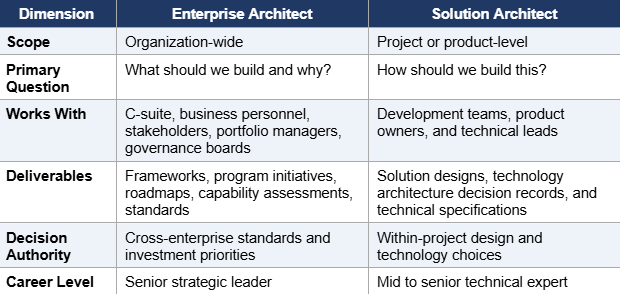
Enterprise architects typically earn more at the mid-career level; at the senior tier, compensation converges. The enterprise architect role generally requires broader business acumen, longer tenure, and a track record of organizational influence, not just project delivery.
How Enterprise and Solution Architects Work Together in Practice
Neither role succeeds in isolation. A common pattern in large organizations: the enterprise architect establishes the common base of understanding for all business understanding, the understanding of the goals to be achieved, the processes required to achieve those goals, the data requirements, the skills to enable those processes, the locations dependencies, and the events that trigger the organization to act, and that all new data systems must meet specific integration and governance standards. A solution architect, tasked with building a new analytics platform, designs within those standards and flags to the enterprise architect when a specific project requirement falls outside the established framework. That conversation is the handshake that keeps organizational architecture coherent.
Enterprise architecture without solution delivery is theory. Solution delivery without enterprise architecture produces a fragmented technology landscape - a collection of individually sensible projects that do not work together at scale. Organizations that invest in both roles and train their architects to operate effectively at each level consistently deliver technology initiatives that align with business goals and do not create compounding technical debt.
The relationship is especially vital and visible, as one example, in US federal government agencies, where enterprise architects govern cross-agency interoperability and compliance, while solution architects handle agency-specific system design. Getting both layers right determines whether a technology program delivers mission value or becomes another cost overrun. The same holds for commercial enterprises with multiple business segments or multiple focus points.
Can a Solution Architect Become an Enterprise Architect?
Yes - and this is one of the most common and well-traveled career paths in the field. Solution architects already have a strong foundation in technical design, delivery constraints, and how architecture decisions create long-term consequences. The gap between the two roles is scope and business acumen, not technical knowledge.
Transitioning from solution architect to enterprise architect means developing the ability to think across the organization rather than within a single project. That requires building skills in governance design, business modeling, capability modeling, strategic alignment, and stakeholder management. Many solution architects make this transition after years of project-level experience - recognizing patterns across enough programs to see the organizational-level problems and opportunities that individual project decisions create.
Practitioner-focused EA certification accelerates that transition significantly. Rather than accumulating insights across years of project work, architects who complete an immersive workshop develop the mental models, frameworks, and communication patterns needed for organizational-level thinking in days. That is not a credential promise - it is a difference in how you see the architecture problem from that point forward.
Why Practitioner Training Matters for Both Roles
Whether you are a solution architect aiming for enterprise-level scope or an enterprise architect working to strengthen your delivery credibility, practitioner-focused training develops skills that neither project experience alone nor exam-based credentials fully provide.
Exam-based programs test knowledge of frameworks and terminology. They do not teach you to build a real Enterprise Architecture for a real organization under real constraints. Practitioners who earn exam-based credentials frequently report that the certification gave them vocabulary, not capability. That gap shows up the first time they are asked to facilitate an EA session or defend an architecture decision to a business manager or CFO.
EACOE's approach is different. Workshops are 75% hands-on practice. Participants develop and present actual architecture deliverables. They work through the situations that derail most EA programs - stakeholder pushback, undefined scope, competing stakeholder priorities, and the persistent gap between clean framework diagrams and implementation reality. That is what "For Practitioners by Practitioners" means. The goal is to Succeed Fast - not to pass an exam and then figure out the rest on the job.
For the EA career track - whether you are entering it from solution architecture, IT leadership, or business analysis - the question is not whether to develop these skills. It is how quickly you can put them to work.
Key Takeaways
Enterprise architects and solution architects both play essential roles in technology-driven organizations, but they operate at different levels of scope and authority. Enterprise architects define the organizational understanding and framework - the standards, roadmaps, and governance structures - within which solution architects design and deliver individual systems. The career path from solution to enterprise architecture is natural and well-established, and is accelerated significantly by practitioner-focused training that develops real-world decision-making skills rather than exam knowledge. Organizations that invest in both roles and equip their architects to operate effectively at each level consistently deliver technology programs that align with business goals and scale without fragmentation. Practitioner certification through EACOE gives architects the tools to Succeed Fast.
Frequently Asked Questions
What is the main difference between an enterprise architect and a solution architect?
An enterprise architect works at the organizational level, defining strategy, standards, and governance structures that apply across all technology investments. A solution architect works at the project level, designing specific systems or applications within the framework that the enterprise architect establishes. The roles are complementary and both are necessary for technology programs to deliver at scale.
Which role earns more - enterprise architect or solution architect?
Enterprise architects typically earn more at the mid-career level, averaging $118,000 to $126,000 annually in the US. Established EACOE Enterprise Architects can earn upwards of $220,000 annually. Senior solution architects can match or exceed that range. At the senior tier, compensation converges, with enterprise architects generally requiring broader business leadership skills to command higher pay.
Can a solution architect move into an enterprise architecture role?
Yes. Solution architects already have a strong foundation in technical design and delivery. The transition to enterprise architecture involves expanding scope from project-level to organizational-level thinking - a shift that practitioner-focused EA training accelerates significantly compared to accumulating experience over years of project work alone.
Do organizations need both an enterprise architect and a solution architect?
Yes. Enterprise architects ensure technology investments align with organizational strategy and work together coherently. Solution architects ensure individual projects are designed and built effectively. Without enterprise architecture, organizations end up with fragmented systems. Without solution architecture, organizational strategy never reaches delivered systems.
What skills does an enterprise architect need beyond technical knowledge?
Enterprise architects need governance design, business modeling, capability modeling, stakeholder management, strategic planning, and the ability to translate business priorities into business and technology roadmaps and investment decisions. Business acumen is as important as technical depth - and is often the capability that limits solution architects from making the move to enterprise-level roles.
What is enterprise architecture certification?
Enterprise architecture certification validates that a practitioner can build, govern, and improve an organization's enterprise architecture. Practitioner-based programs like EACOE focus on applying real methodologies to real deliverables in a structured workshop environment. Exam-based programs like TOGAF® test familiarity with frameworks and terminology. The two are not equivalent in practice - one gives you vocabulary, the other gives you capability.
The distinction between enterprise architect and solution architect is not just a job title difference - it is a difference in scope, authority, and career trajectory. Understanding what each role begins and ends, and how the two work together, is the foundation of a well-governed EA practice.
Get certified as an enterprise architect through EACOE's immersive practitioner workshop - 75% hands-on, designed to prepare you for organizational-level architecture from your first day back. Register for the next workshop and Succeed Fast.