Cart 0

 Additional Enterprise Architecture Support


Enterprise Architecture Coaching Program

Focused Performance and Leadership Growth for Enterprise Architecture Professionals

Transform Your Practice with Structured, Purposeful Coaching

Personal coaching is a structured, time-bound process designed to help you achieve measurable goals and strengthen critical skills in your Enterprise Architecture practice. Our approach blends insight, accountability, and challenge to generate meaningful progress and lasting results.

Through guided questioning, targeted feedback, and actionable planning, you will gain clarity on your objectives, experiment with new behaviors, and stay accountable to your commitments. Coaching engagements typically follow a regular, consistent schedule over a few months - focused on improving performance, leadership effectiveness, or specific initiative gaps.

What Makes This Program Different

Time Horizon: Short-term and goal-specific for visible results.

Focus: Enhance performance, leadership, and applied skills.

Approach: Facilitated through inquiry and challenge - helping you uncover and act on your own best solutions.

Structure: Formal process with defined outcomes, cadence, and clear measurement of success.


Who Should Enroll

This coaching program is designed for Enterprise Architecture professionals who:

  • Face specific performance or leadership challenges in their current role.

  • Want to accelerate career advancement through targeted skill development.

  • Need accountability and structure to break through persistent initiative gaps.

  • Seek an experienced partner to challenge assumptions and refine their approach.

  • Are committed to investing time and effort in measurable professional growth.

What You Will Achieve

Coaching clients typically experience:

  • Clarity on Strategic Direction - Define and prioritize objectives that align with organizational goals and personal career aspirations.

  • Enhanced Leadership Effectiveness - Develop behaviors and communication patterns that increase influence and impact.

  • Breakthrough on Persistent Challenges - Identify and address blind spots or patterns that have been holding you back.

  • Practical Skills Application - Experiment with new techniques in real-world scenarios with guided feedback and refinement.

  • Measurable Performance Gains - Track progress against defined outcomes and celebrate tangible results.


Is Coaching Right for You?

Consider these questions as you explore whether personalized coaching aligns with your development goals:

  1. What is the biggest challenge you are facing right now in your Enterprise Architecture practice?

  2. What specific outcomes would make this coaching investment worthwhile for you?

  3. What patterns or blind spots do you suspect might currently be holding you back?

  4. Is your organization supporting this investment, or is it personal?

  5. What is your preferred meeting format: In-person, video, or phone?

If you have clear answers to these questions - or if the questions themselves reveal areas where you need support - you are an ideal candidate for this program.

Your investment

Coaching engagements are structured as follows:

  • Duration: 3-6 months (customized to your goals)

  • Session Frequency: Biweekly or monthly meetings

  • Session Length: 60-90 minutes per session

  • Format: In-person, video conference, or phone (your choice)

  • Deliverables: Action plans, progress tracking, and outcome measurement

Pricing is customized based on engagement length, session frequency, and organizational vs. individual sponsorship.

Contact us for a detailed proposal tailored to your needs.


About Your Coach

With over 50 years of hands-on experience in Enterprise Architecture and Business Architecture, Samuel B. Holcman brings practical, proven expertise to every coaching engagement. As the creator of the EACOE and BACOE certification, methodology, and frameworks, Samuel has pioneered methodologies that deliver measurable ROI and career acceleration for architecture professionals worldwide.

Samuel's coaching approach is direct, challenging, and results focused. He does not provide theoretical advice - he partners with you to generate solutions grounded in real-world implementation experience. His clients consistently report breakthrough insights, accelerated career advancement, and measurable performance improvements.

Take the Next Step

If you are ready to accelerate your growth and deliver greater impact in your Enterprise Architecture role, let us start the conversation.

Schedule a complimentary 30-minute discovery session to:

  • Discuss your current challenges and development goals.

  • Explore whether coaching is the right fit for your needs.

  • Define potential outcomes and success criteria.

  • Determine the optimal engagement structure and timeline.

Contact Information:

  • Email: Sam@EACOE.org

  • Phone: 810-231-0531

  • Website: www.EACOE.org

  • LinkedIn: https://www.linkedin.com/in/samuel-holcman

What Clients Are Saying

"Samuel's coaching challenged me to rethink assumptions I did not even know I was making. Within three months, I had clarity on my career direction and a concrete plan to get there. The investment paid for itself in my next performance review."
— Senior Business Architect, Fortune 500 Financial Services

"I came in with vague frustrations about my role. Sam’s questioning helped me pinpoint exactly what was holding me back - and, more importantly, what I needed to do about it. His approach is direct, practical, and effective."
— Lead Business Architect, Global Technology Firm

"This is not soft-skills fluff. Sam brings decades of real implementation experience and uses it to help you solve actual problems. The accountability structure kept me on track, and the results were measurable."
— Principal Business Architect, Healthcare Systems

Ready to transform your Enterprise Architecture practice?

Contact us today to schedule your complimentary discovery session.

Enterprise Architecture Mentorship Program

Navigate Your Career with Wisdom from 50+ Years of Architecture Leadership

The Challenge of Navigating Architecture Careers Alone

You have built technical competence. You deliver quality work. But when it comes to the bigger questions - Where should my career go next? How do I position myself for leadership? What decisions will I regret in five years? There is no playbook.

Enterprise Architecture Mentorship provides what technical training cannot: the wisdom, perspective, and guidance that comes from someone who has already navigated the path you are on.

This is not coaching focused on fixing specific performance gaps. This is long-term relationship-based guidance designed to accelerate your career trajectory, sharpen your professional judgment, and help you avoid the costly mistakes that derail promising architects.

What Is Enterprise Architecture Mentorship?

Mentorship is a longer-term, relationship-based process in which a more experienced professional shares knowledge, perspectives, and advice to support your overall growth and career journey.

Unlike coaching - which focuses on specific, measurable goals and performance improvement, mentorship draws heavily on the mentor's own experience, offering insight into:

  • Navigating organizational dynamics and political realities

  • Making strategic career decisions at critical inflection points

  • Building influence and credibility with executive stakeholders

  • Developing professional judgment that comes only from lived experience.

  • Expanding networks and understanding how to leverage relationships

  • Positioning yourself for advancement and leadership opportunities

Mentoring conversations tend to be more informal and holistic, touching on identity, aspirations, long-range development, and the "unwritten rules" that determine architecture career success.


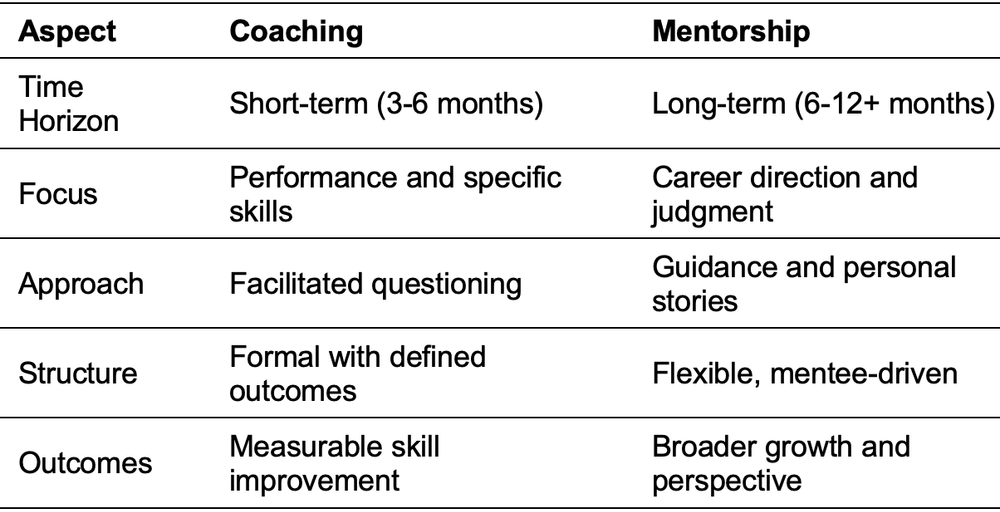
Mentorship versus Coaching: Understanding the Difference


When to choose mentorship: You have a solid foundation but need guidance on where to go next, how to position yourself strategically, and what patterns to watch for as you advance.

When to choose coaching: You have specific performance gaps or skill deficits that need structured improvement within a defined timeframe.

What You Will Gain from Mentorship: Enterprise Architecture Mentorship focuses on four critical development areas that determine long-term career success:


1. Career Direction and Strategy

Gain clarity on where you want your career to go and how to get there, including roles to pursue, skills to develop, and strategic positioning decisions.

  • Assessing career options and trade-offs at inflection points.

  • Understanding different architecture career paths (technical depth vs. leadership breadth).

  • Positioning yourself for advancement within your organization or industry.

  • Recognizing when to stay, when to move, and how to evaluate opportunities.

Building a personal brand that attracts the right opportunities.

2. Professional Judgment and Decision-Making

Develop the pattern recognition and situational judgment that separates experienced architects from novices - knowing when to push, when to compromise, and when to walk away.

  • Reading organizational dynamics and political currents.

  • Choosing your battles and managing stakeholder conflicts.

  • Balancing technical purity with pragmatic enterprise needs.

  • Recognizing warning signs before projects go off-track.

  • Learning from others' mistakes instead of making them yourself.


3. Network and Influence Building

Expand your professional network and learn how to leverage relationships to increase your impact and create opportunities.

  • Building authentic relationships with executives and key decision-makers.

  • Leveraging networks for career advancement and opportunity access.

  • Understanding how architecture leaders build and maintain influence.

  • Navigating industry communities and professional organizations strategically.

Creating visibility for your work and expertise.

4. Identity and Long-Range Growth

Clarify your professional identity, values, and aspirations - ensuring your career trajectory aligns with who you are and who you want to become.

  • Defining success on your own terms (not just climbing the ladder).

  • Balancing career ambition with personal priorities and values.

  • Developing leadership presence and executive credibility.

  • Understanding your unique strengths and how to leverage them.

  • Building resilience and navigating setbacks without losing momentum.


How the Mentorship Program Works

Enterprise Architecture Mentorship is designed to be flexible, mentee-driven, and responsive to your evolving needs over time.


Engagement Structure

  • Duration: 6-12 months (renewable based on mutual interest).

  • Meeting Frequency: Monthly 60–90-minute conversations (more frequent during critical decision periods).

  • Format: In-person, video conference, or phone (your preference).

  • Between-Session Access: Email or brief phone calls for time-sensitive questions or decisions.

  • No Formal Agenda: Conversations are driven by your questions, challenges, and development priorities.

Typical Mentorship Flow

Initial Conversations (Months 1-2):

  • Explore your career history, current situation, and aspirations.

  • Identify patterns, blind spots, and development opportunities.

  • Establish relationship foundation and communication norms.

Ongoing Development (Months 3-10):

  • Regular conversations addressing current challenges and decisions.

  • Guidance on navigating organizational dynamics and stakeholder situations.

  • Career strategy discussions and opportunity evaluation.

  • Network introductions and industry insight-sharing.

Reflection and Transition (Months 11-12):

  • Review of progress and growth over the engagement period.

  • Assess readiness for next career stage or leadership opportunity.

  • Determine whether to continue mentorship or transition to periodic check-ins.

Is Mentorship Right for You?

Consider these questions as you explore whether long-term mentorship aligns with your development needs:

  1. What is the biggest challenge you are facing right now in your Enterprise Architecture practice?

  2. Where do you see your career in 3-5 years?

  3. What areas of professional growth matter most to you right now?

  4. Have you had a professional mentor? What made it valuable or what was missing?

  5. Is your organization supporting this investment, or is it personal?

  6. What is your preferred meeting format: In-person, video, or phone?

If these questions resonate - or if you find yourself wishing, you had someone to discuss them with - you are an ideal candidate for mentorship.

Who Should Seek Mentorship

Enterprise Architecture Mentorship is designed for:

  • Mid-career architects navigating the transition from practitioner to senior practitioner to leader.

  • Senior architects considering executive or enterprise-level roles.

  • Practice leads building Enterprise Architecture Initiatives within their organizations.

  • Career transitioners moving into Enterprise Architecture from adjacent disciplines.

  • High-potential architects seeking to accelerate their trajectory with strategic guidance.

Prerequisites: 2+ years of architecture experience and demonstrated commitment to professional growth. You should have a solid foundation and be ready to focus on broader career development.


Your investment

Mentorship engagements are structured as follows, with variable pricing:

  • 6-Month Engagement: (monthly conversations plus email access)

  • 12-Month Engagement: (monthly conversations plus email access)

  • Extended Engagement: after initial commitment period

What is Included:

  • Monthly 60–90-minute mentorship conversations (in-person, video, or phone).

  • Email or brief phone access for time-sensitive questions between sessions.

  • Career strategy discussions and opportunity evaluation.

  • Network introductions and industry insight-sharing.

  • Review of resumes, LinkedIn profiles, or presentation materials as needed.

  • Ongoing relationship and support throughout engagement period.

Organizational Sponsorship: Many organizations support mentorship as professional development. We can provide documentation and structure to facilitate organizational approval and reimbursement.


About Your Mentor

Samuel B. Holcman brings over 50 years of hands-on Enterprise Architecture and Business Architecture experience to mentorship relationships. As the creator of BACOE and EACOE certification and frameworks, Samuel has navigated every stage of the architecture career journey - from practitioner to thought leader - and understands the challenges, inflection points, and strategic decisions that define long-term success.

Samuel's mentoring approach is direct, candid, and grounded in lived experience. He shares both successes and failures, offering the kind of unvarnished perspective you will not find in textbooks or training programs. His mentees consistently report breakthrough insights about career strategy, accelerated advancement, and greater confidence in navigating complex organizational dynamics.

Career Highlights:

  • Creator of BACOE and EACOE certification, methodologies, and frameworks.

  • 50+ years of Enterprise Architecture and Business Architecture implementation.

  • Recognized in Marquis Who's Who for contributions to the field.

  • Published author and thought leader in architecture methodology.

  • Navigated practitioner, leadership, executive, and thought leader roles across multiple industries.

What makes Samuel's mentorship unique: He has walked the entire path - from early-career architect to recognized industry pioneer - and can provide guidance grounded in both technical excellence and strategic career navigation.


What Mentees Say

"Samuel's mentorship changed how I think about my career. He helped me see patterns I was blind to and gave me the confidence to pursue opportunities I would have passed on. Two years later, I am in a role I did not think was possible—and I know exactly how I got here."
— Principal Business Architect, Financial Services

"I came to mentorship with technical skills but no career strategy. Samuel helped me understand how architecture careers actually work - not the official story, but the real dynamics of advancement, influence, and positioning. That perspective has been invaluable."
— Senior Enterprise Architect, Technology

"The best investment I have made in my career. Samuel's guidance helped me avoid mistakes that would have cost me years of progress. More importantly, he helped me clarify what success actually means to me - not just climbing the ladder."
— Lead Business Architect, Healthcare


Ready to Navigate Your Career with Experienced Guidance?

If you are ready to accelerate your growth and navigate your Enterprise Architecture career with wisdom from someone who has already walked the path, let us start the conversation.

Contact us today to begin your Enterprise Architecture mentorship journey:

  • Email: Sam@EACOE.org

  • Phone: (810) 231-0531

  • Website: www.EACOE.org

  • LinkedIn: https://www.linkedin.com/in/samuel-holcman

You do not have to navigate your architecture career alone. Gain the wisdom and perspective that comes from 50+ years of experience.


Frequently Asked Questions

Q: What if my organization will not pay for mentorship?
A: Many mentees invest personally in their career development. The 6-month engagement option allows you to experience the value before committing to a longer timeline. We also offer payment plans for personal investments.

Q: I am mid-career but not yet senior. Is mentorship still appropriate?
A: Absolutely. Mid-career is often the ideal time for mentorship - you have enough experience to ask sophisticated questions and enough runway ahead to benefit from strategic guidance. Many of our most successful mentorship relationships begin at this stage.

Q: What if I am not sure whether I need coaching or mentorship?
A: The exploratory conversation will help clarify which approach fits your current needs. Some architects benefit from starting with coaching to address specific performance gaps, then transitioning to mentorship for longer-term career guidance.

Q: Can I switch from coaching to mentorship (or vice versa)?
A: Yes. Some relationships begin as coaching and evolve into mentorship as the focus shifts from skill development to career strategy. We will regularly assess whether the current approach is serving your needs.


Compare Your Options: Coaching vs. Mentorship

Still unsure which program fits your needs? Here is a quick decision guide:

Choose Coaching if:

  • You have specific performance or skill gaps to address.

  • You need structured accountability and action plans.

  • You want measurable improvement within 3-6 months.

  • You learn best through facilitated self-discovery.

Choose Mentorship if:

  • You are navigating career direction and strategic decisions.

  • You want guidance from someone who has walked the path.

  • You need perspective on organizational dynamics and long-term growth.

  • You value informal, relationship-based development over structured programs.


Choose Both (Sequentially) if:

  • You have immediate performance needs plus longer-term career questions.

  • You benefit from different approaches at different career stages.


Begin Your Mentorship Journey

Wisdom shortens the path. Experience accelerates growth. Guidance prevents costly mistakes.

Contact us today to schedule your complimentary exploratory conversation and discover how Enterprise Architecture Mentorship can accelerate your career trajectory.

Schedule Your Conversation | Email Us | Call Now


Bridge Classroom Learning with Real-World Implementation: Develop Your Enterprise Architecture 0.3 and Deliver Quick Wins

From Theory to Practice: Hands-On Enterprise Architecture Development

The EACOE Immersion Program is designed for organizations ready to move beyond training and into implementation. This intensive, on-site engagement combines EACOE methodology with hands-on guidance to develop a working "0.3" version of your Enterprise Architecture Framework for a specific enterprise unit - complete with validated artifacts, prioritized initiatives, and an actionable implementation roadmap.

Unlike traditional training programs that end with classroom exercises, the Immersion Program embeds an experienced Enterprise Architecture practitioner directly within your team to build real artifacts, establish enterprise context, and create a plan that delivers measurable results quickly.


What Is the EACOE Immersion Program?

The Immersion Program focuses on developing Enterprise Architecture artifacts within the EACOE Enterprise Architecture framework and methodology for a targeted enterprise unit or functional area. Working collaboratively with your internal team, we will:

  • Establish a clear enterprise context by identifying strategic priorities and stakeholder needs.

  • Develop foundational Enterprise Architecture artifacts.

  • Validate models and documentation to ensure alignment with current enterprise realities.

  • Evaluate and prioritize enterprise initiatives based on strategic importance and maturity.

  • Create a roadmap designed to deliver quick wins and build momentum.

  • Provide on-site, hands-on guidance to accelerate your internal Enterprise Architecture team's competence and confidence.

The result is a tangible, actionable Enterprise Architecture 0.3 - a solid foundation your team can immediately use to guide decision-making, prioritize investments, and drive transformation initiatives.  This is sometimes referred to as “proof of concept” or a “demonstration project, giving those with classroom training the opportunity to go to the next level of competency – a demonstration tuned to the organization itself.


Program Deliverables

Enterprise Context: Strategic priorities, stakeholder analysis, and Enterprise unit scope definition.

Core EA Artifacts: Goals, Process, Material, Roles, Location and Event models. Implementation Models and Developed Initiatives aligned with organization goals.

Initiative Assessment: Evaluation of existing initiatives with maturity ratings and gap analysis.

Implementation Roadmap: Prioritized action plan with quick-win initiatives, timelines, and resource requirements.

Model Validation: Review and validation of models, identifying gaps and redundancies.

Team Enablement: On-site coaching and knowledge transfer to build internal team initiative.


Why "0.3" Matters

An Enterprise Architecture 0.3 is intentionally designed to be practical, actionable, and improvable. Rather than pursuing perfection, we focus on developing a working baseline that:

  • Provides immediate value to practitioners, stakeholders and decision-makers.

  • Establishes a common language and shared understanding across the Enterprise unit.

  • Serves as a reference point for future architecture evolution and refinement.

  • Delivers quick wins that build credibility and momentum for the Enterprise Architecture practice.

  • Creates a foundation for subsequent iterations and enhancements.

The 0.3 approach recognizes that 30% completion with immediate application beats 100% “misdirection” that sits on a shelf unused.

What the Program Enables

Once your Enterprise Architecture 0.3 is in place, your organization will be positioned to:

  1. Validate and enhance existing models using a structured, repeatable approach.

  2. Conduct targeted Enterprise Architecture activities aligned with strategic priorities.

  3. Develop and refine enterprise initiatives based on maturity assessments and enterprise needs.

  4. Evaluate initiative readiness for transformation initiatives and investment decisions.

  5. Develop systems programs that align technology investments with enterprise priorities.

  6. Build or acquire implementations consistent with validated enterprise unit needs.

  7. Establish governance processes to maintain and evolve the Enterprise Architecture over time.

The Immersion Program creates both the artifacts and the organizational initiative to sustain and advance your Enterprise Architecture practice independently.


Who Should Participate

The EACOE Immersion Program is ideal for:

  • Organizations launching or accelerating a Enterprise Architecture practice.

  • Enterprise units pursuing transformation initiatives requiring a solid architectural foundation.

  • Internal EA teams that have completed EACOE training and need hands-on implementation guidance.

  • Enterprises seeking to validate and improve existing Enterprise Architecture efforts.

  • Leadership teams requiring tangible artifacts to inform strategic decision-making.

Prerequisite: At least one internal team member should have completed EACOE certification training to ensure foundational knowledge and maximize program effectiveness.

Program Structure and Duration

The Immersion Program is customized to your organization's scope, complexity, and readiness. Typical engagements include:

  • Duration: 10 business days (depending on enterprise unit scope and complexity)

  • Delivery Model: On-site immersion with your internal team (hybrid options available)

  • Session Cadence: Full-time or part-time engagement based on organizational capacity.

  • Team Involvement: Core team of 3-6 internal participants working directly with the EACOE practitioner.

Flexible Engagement Options:

  • Intensive Sprint: Full-time, two week engagement for rapid baseline development

  • Extended Partnership: Part-time, 8–12-week engagement allowing for deeper stakeholder alignment.

  • Hybrid Model: Combination of on-site workshops and remote collaboration


The EACOE Immersion Approach

Our methodology integrates EACOE principles with proven implementation practices:

Phase 1: Discovery and Context Setting

  • Strategic priority assessment.

  • Enterprise unit scope definition and boundary identification.

  • Review of existing documentation, models, and architecture artifacts.

  • Establishment of success criteria and quick-win targets.

Phase 2: Artifact Development

  • Collaborative development of core Enterprise Architecture artifacts.

  • Initiative development workshops.

  • Model development aligned with enterprise terminology.

  • Initiative maturity assessment and gap analysis.

Phase 3: Roadmap and Planning

  • Prioritization of initiatives based on strategic importance and maturity.

  • Identification of quick-win opportunities and implementation sequences.

  • Development of implementation roadmap with timelines and resource requirements.

  • Validation sessions.

Phase 4: Enablement and Transition

  • Knowledge transfer and team coaching on artifact maintenance.

  • Establishment of governance processes and update cadence.

  • Documentation of methods, tools, and best practices.

  • Transition planning for ongoing, independent operations.


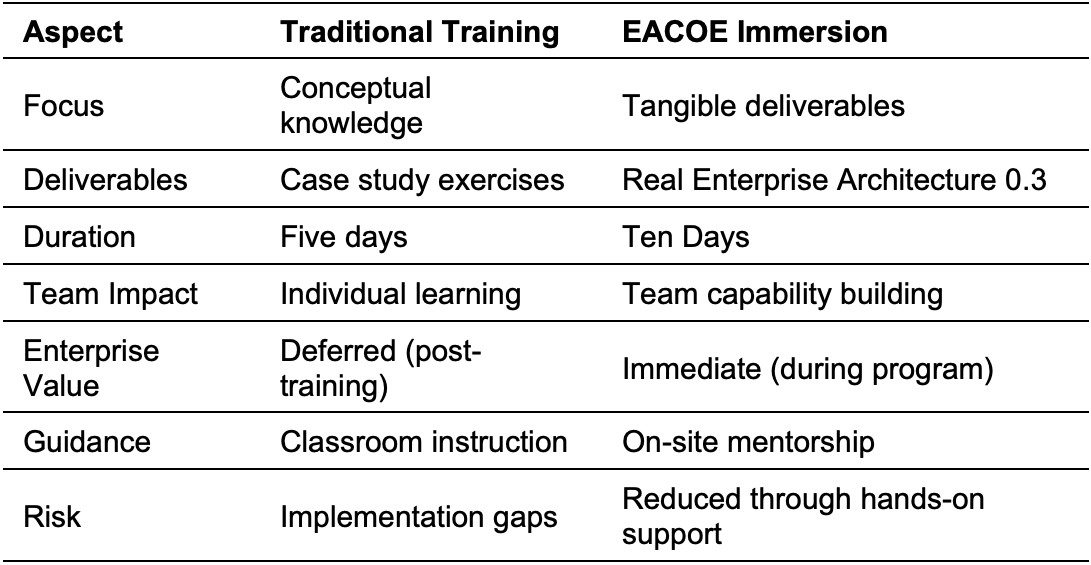
What Makes This Program Different from Traditional Training


The Immersion Program bridges the gap between knowing what to do and actually doing it.

Your investment

Immersion Program pricing is customized based on:

  • Enterprise unit scope and organizational complexity.

  • Engagement duration and delivery model (intensive vs. extended).

  • On-site vs. hybrid delivery requirements.

  • Number of internal team members participating.

  • Extent of existing documentation and prior EA efforts.

What's Included:

  • Full-time or part-time on-site practitioner engagement.

  • Development of all core Enterprise Architecture 0.3 artifacts.

  • Enterprise Architecture facilitation and validation sessions.

  • Roadmap and prioritization framework.

  • Knowledge transfer and team coaching.

  • Post-engagement support for transition (30-60 days).

Contact us for a detailed proposal tailored to your specific needs and organizational context.


About Your EACOE Immersion Guide

With over 50 years of hands-on Enterprise Architecture and Business Architecture experience, Samuel B. Holcman has pioneered methodologies that deliver measurable enterprise value and accelerate organizational initiative. As the creator of the EACOE (Enterprise Architecture Certification Of Excellence) methodology, and framework, Samuel brings practical, proven expertise to every Immersion engagement.

Samuel's approach is direct, collaborative, and results focused. He does not deliver theoretical models - he partners with your team to build working artifacts grounded in real-world implementation experience. His clients consistently report accelerated initiative development, stakeholder confidence in Enterprise Architecture, and tangible enterprise outcomes from the artifacts produced.

Credentials:

  • Creator of EACOE and BACOE certification methodologies, and frameworks.

  • 50+ years of hands-on architecture implementation experience.

  • Recognized in Marquis Who's Who for contributions to the field.

    • Published author and thought leader in Enterprise Architecture methodology.


Ready to Move from Training to Implementation?

If your organization is ready to develop a working Enterprise Architecture 0.3 and deliver measurable results quickly, let us start the conversation.

Schedule a complimentary 30-minute consultation to:

  • Assess your current Enterprise Architecture maturity and readiness.

  • Define the scope and priorities for your Immersion engagement.

  • Explore potential quick-win opportunities and success criteria.

  • Determine the optimal engagement structure, duration, and team composition.

  • Review case studies and examples from similar Immersion engagements.

Take the Next Step: Schedule Your Consultation

Contact us today to explore how the EACOE Immersion Program can accelerate your Enterprise Architecture practice:

  • Email: Sam@EACOE.org

  • Phone: 810-231-0531

  • Website: www.EACOE.org

  • LinkedIn: https://www.linkedin.com/in/samuel-holcman

Do not let your Enterprise Architecture training sit on the shelf. Turn classroom learning into enterprise results with hands-on Immersion.


Frequently Asked Questions

Q: What if we have not completed EACOE training yet?
A: We recommend at least one core team member complete EACOE certification before the Immersion Program to ensure foundational knowledge. However, we can integrate foundational training into the Immersion engagement if needed.

Q: Can the program be delivered remotely?
A: While on-site delivery maximizes collaboration and impact, we offer hybrid models combining on-site workshops with remote collaboration sessions. Fully remote delivery is available but typically requires extended timelines.

Q: What happens after the Immersion Program ends?
A: Your team will have a complete Enterprise Architecture 0.3, a “demonstration project” for both architecture activities, as importantly, an example to engage stakeholders with “real” context specific content, and documented methods, and the initiative to maintain and evolve it independently. We offer optional post-engagement support packages for continued guidance during the first 60-90 days of independent operation.

Q: How is this different from consulting?
A: Traditional consulting often delivers artifacts created by external consultants, and usually is not deliverable, time, or fixed fee based. The Immersion Program emphasizes collaborative development where your team builds the artifacts under expert guidance, ensuring knowledge transfer and long-term initiative.

Q: What size enterprise unit is appropriate for this program?
A: The program scales from single departments to entire enterprise units. Scope is defined during the consultation phase to ensure feasible deliverables within the engagement timeframe.

Q: Do you work with multiple enterprise units simultaneously?
A: We typically focus on one enterprise unit at a time to maximize depth and team initiative building. Once the first unit's 0.3 is complete, we can replicate the approach for additional units with shorter cycle times due to organizational learning.


What Organizations Are Saying

"The Immersion Program gave us exactly what we needed - real artifacts, not theoretical models. Samuel worked alongside our team to build our Business Architecture 0.3, and we had quick wins within the first month. The investment paid for itself in avoided missteps alone."
— VP of Business Transformation, Global Financial Services

"We had sent our team to training from other providers but struggled to apply it. The Immersion Program bridged that gap. Having Samuel on-site to guide us through real decisions with real data made all the difference. Our stakeholders now have confidence in our Business Architecture."
— Director of Business Architecture, Healthcare Technology

"This is not training – it is development and implementation. We walked away with working artifacts, a clear roadmap, and the capability to maintain it ourselves. The hands-on approach accelerated our maturity by at least 18 months."
— Chief Architect, Manufacturing Enterprise


Soft Skills For Architects Training

Master the Human Side of Architecture - Because Technical Excellence Alone Is Not Enough

The Missing Piece in Architecture Success

You know how to develop architectures. You understand frameworks, methodologies, and technical modeling. But here is the hard truth: technical competence alone will not make you successful.

The difference between architects who transform organizations and those whose work sits unused on shelves is not technical skill - it is the ability to engage stakeholders, facilitate collaboration, drive adoption, and communicate value effectively.

Soft Skills for Architects Training equips you with interpersonal and organizational initiatives that turn technical expertise into enterprise impact.

Why Soft Skills Matter More Than You Think

Over 50 years of architecture implementation experience has proven one undeniable truth: soft skills are just as important - perhaps even more important - than hard skills.

An architect may have mastered every process, tool, and template for developing architectures. But it is impossible to develop architectures in a vacuum. Without the necessary people skills, the architect will not be successful in:

  • Engaging the right people at the right time with the right message

  • Understanding diverse perspectives across enterprise units, leadership levels, and functional areas

  • Building deliverables that stakeholders actually adopt and use

  • Navigating organizational politics and resistance to change

  • Communicating complex concepts in language that resonates with non-technical audiences.

  • Facilitating productive conversations that generate alignment and commitment.

The result? Even the most technically sound architecture fails to deliver value if it cannot gain organizational traction.

This training closes that gap.


What You Will Learn

Soft Skills for Architects Training focuses on four critical competency areas that accelerate architecture adoption and impact:

1. Facilitation Skills

Learn to design and lead effective workshops, stakeholder sessions, and collaborative modeling exercises that generate insights, alignment, and actionable outcomes.

  • Structuring workshops for maximum engagement and productivity.

  • Managing group dynamics and difficult personalities.

  • Using questioning techniques to surface hidden assumptions and requirements.

  • Keeping sessions focused while allowing space for exploration.

  • Capturing and synthesizing diverse inputs into coherent outputs.

2. Collaboration Skills

Develop the ability to work effectively across organizational boundaries, building relationships that enable architecture work to move forward.

  • Building trust and credibility with business and technical stakeholders.

  • Navigating competing priorities and conflicting perspectives.

  • Creating coalitions and securing buy-in from skeptics.

  • Leveraging influence without formal authority.

  • Partnering with business leaders to co-create solutions.

3. Change Agent Skills

Position yourself as a catalyst for transformation, helping organizations embrace new ways of working and thinking about architecture.

  • Understanding organizational change dynamics and resistance patterns.

  • Identifying and engaging change champions at multiple levels.

  • Communicating the case for change in compelling, relevant terms.

  • Managing stakeholder expectations and addressing concerns proactively.

  • Building momentum through quick wins and visible progress.

4. Communication Skills

Master the art of translating architecture concepts into language that resonates with business leaders, executives, and operational teams.

  • Tailoring messages to different audiences (C-suite, middle management, practitioners).

  • Using storytelling and analogies to make abstract concepts concrete.

  • Developing compelling presentations that drive decisions.

  • Writing clear, concise documentation that stakeholders actually read.

  • Listening actively to understand unstated needs and priorities.

Training Format and Structure

Soft Skills for Architects Training is an interactive, practical program designed for immediate application:

  • Duration: 3 days instruction and practice

  • Delivery: In-person or virtual instructor-led sessions

  • Format: Combination of instruction, case studies, role-playing, and group exercises

  • Materials: Comprehensive participant workbook with tools, templates, and job aids

  • Practice Focus: Real-world scenarios and situations from architecture practice.

Who Should Attend

This training is designed for:

  • Enterprise Architects seeking to increase organizational impact and adoption.

  • Business Architects who need to engage diverse stakeholders effectively.

  • Solution Architects responsible for driving alignment across business and IT.

  • Architecture Team Leads building initiative within their teams.

  • Emerging Architects who want to accelerate their career trajectory

Prerequisites: Basic understanding of enterprise architecture or business architecture and at least one year of architecture practice experience recommended (but not required).


What Participants Say

"I thought I was a pretty good facilitator until I took this training. The techniques I learned transformed how I run stakeholder sessions - engagement is higher, outcomes are clearer, and adoption is faster."
— Senior Enterprise Architect, Technology Services

"This training taught me how to speak the language of business leaders. I stopped talking about models and started talking about business outcomes. That shift alone has made me exponentially more effective."
— Principal Business Architect, Financial Services

"The change agent module was a gamechanger. I finally understood why some of my architecture work gained traction and some did not. Now I approach every engagement with a clear adoption strategy."
— Lead Solution Architect, Healthcare


Your investment

Standard Training Fee: See Current Pricing per participant

What Is Included:

  • Three full days of interactive instruction and practice

  • Comprehensive participant workbook

  • Tools, templates, and job aids for immediate application

  • Certificate of completion

  • 90 days of post-training email support

  • Access to online resource library

Special Offer for Certified EACOE Enterprise Architects or Certified BACOE Business Architects.

Thirty percent Discount Available

EACOE and BACOE receive a 30% reduction on Soft Skills for Architects Training:

  • Discount applies to both in-person and virtual delivery formats.

Group Rates: Contact us for pricing on team registrations (3+ participants from the same organization).


The ROI of Soft Skills Development

Consider the cost of architecture work that does not get adopted:

  • Months of effort developing frameworks that sit unused.

  • Stakeholder frustration and declining engagement over time

  • Missed opportunities because architecture insights were not effectively communicated.

  • Career stagnation due to perception of "not being strategic enough."

Participants consistently report that a single successful stakeholder engagement using techniques from this training delivers ROI that exceeds the training investment multiple times over.


Upcoming Training Dates

See the Soft Skills For Architects Websites for current schedule.

Private Team Sessions:

We offer customized on-site or virtual delivery for organizations with 5+ participants. Contact us to schedule a session tailored to your team's specific needs and organizational context.


About Your Instructor

Samuel B. Holcman brings over 50 years of hands-on architecture experience to Soft Skills for Architects Training. As the creator of EACOE and BACOE certification frameworks, Samuel has personally navigated the challenges of gaining organizational buy-in, facilitating complex stakeholder sessions, and driving architecture adoption across diverse enterprise environments.

Samuel's teaching approach is direct, practical, and grounded in real-world experience. He does not teach soft skills theory—he shares battle-tested techniques that have proven effective in hundreds of architecture engagements across multiple industries.

Credentials:

  • Creator of EACOE and BACOE certification frameworks

  • 50+ years of Enterprise Architecture and Business Architecture implementation

  • Recognized in Marquis Who's Who for contributions to the field.

  • Published author and thought leader in architecture methodology.


Register Today and Transform Your Architecture Practice

Do not let technical excellence go to waste because of gaps in interpersonal effectiveness.

Soft Skills for Architects Training gives you the facilitation, collaboration, change, and communication initiatives that separate high-impact architects from the rest.

Ready to Register?

Visit: https://www.softskillsforarchitects.com/training-registration

Questions? Contact us:

  • Email: Sam@ArchitectuesCOE.org

  • Phone: 810-231-0531

  • Website: www.SoftSkillsForArchitects.com


Frequently Asked Questions


Q: Is this training only for experienced architects?
A: While one year of architecture practice is recommended, emerging architects often benefit most from learning soft skills early in their careers. The techniques taught are applicable regardless of experience level. So the direct answer is no.

Q: How is this different from generic leadership training?
A: This training is specifically designed for architects facing the unique challenges of stakeholder engagement, technical-to-enterprise translation, and architecture adoption. All scenarios, exercises, and examples come directly from architecture practice.

Q: Can I attend if I am not EACOE or BACOE certified?
A: Absolutely. The training is open to all architects. EACOE and BACOE certified professionals receive a 30% discount, but certification is not required to attend.

Q: Is there a virtual option?
A: Yes. We offer both in-person and virtual instructor-led sessions. The virtual format maintains the same interactivity and practice focus as in-person delivery.

Q: What if I need to cancel or reschedule?
A: Full refund if canceled thirty plus days before training. Transfers to future sessions allowed up to fourteen days before the start date of training. See registration page for complete policy.

Q: Do you offer this training in-house for our team?
A: Yes. We provide customized on-site or virtual delivery for organizations with 5+ participants. Contact us to discuss tailoring content to your organization's specific context and challenges.

Take the Next Step

Technical skills got you here. Soft skills will take you further.

Register now for Soft Skills for Architects Training and master the human side of architecture success.